
Measuring SEO results is harder than measuring advertising: you pay every month, but the effect builds gradually and depends on many factors. That's why many business owners look at their agency's report, see a table of rankings and can't tell whether it's worth continuing.
In this article we'll look at which metrics actually show the value of SEO, which KPIs make sense to include in a contract, what a monthly report should contain, and how to double-check the data yourself without being a specialist.
Why rankings are a poor headline metric
Rankings for a keyword list are the most familiar report format, but they have serious limitations. Search results are personalized and depend on location and device, and the agency picks the keyword list itself. It's easy to include rare queries that are simple to rank for but bring neither visitors nor leads.
Rankings are useful as a diagnostic indicator: they show which sections are growing and which are slipping. But judging the overall outcome by them is like judging a store by the number of shop windows rather than by revenue.
SEO metrics by level: from visibility to revenue
It helps to view SEO results as a funnel. Each level is closer to money, and problems on one level explain failures on the next.
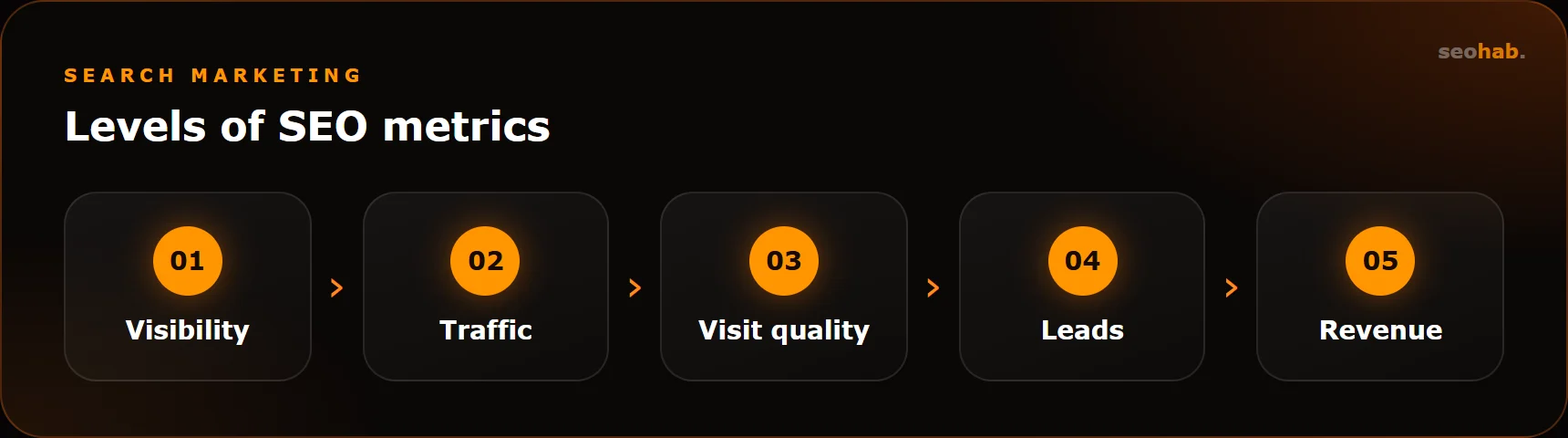
Visibility
Search impressions and the number of queries the site appears for. Sources: the Performance report in Google Search Console and Search queries in Yandex Webmaster. Growing visibility is an early sign that the work is heading in the right direction.
Traffic
Organic search sessions in GA4 and Yandex Metrica. It's important to split traffic into branded and non-branded: people searching for your name would come anyway. The real credit for SEO is growth in non-branded traffic.
Visit quality
Bounce rate, pages per session, time on site, engagement. If traffic grows but quality drops, the site is attracting the wrong audience or the landing pages don't answer the query.
Conversions and revenue
Leads, calls, orders and revenue from organic search. This is the most important level, and the hardest to track: you need goals in analytics, call tracking and deal data passed back from your CRM. Without that, you only see the top of the funnel.
Which KPIs to put in the contract
An honest agency won't promise specific rankings or a date for reaching the top: search algorithms don't answer to them. What they can be accountable for is the work itself and measurable trends.
- Work KPIs: a monthly plan and its completion — pages optimized, technical issues fixed, articles written.
- Visibility KPIs: growth in top-10 queries for an agreed keyword set, search impressions.
- Traffic KPIs: the trend of non-branded organic traffic to target sections.
- Business KPIs: the number of leads or orders from organic search and the cost per lead.
The best setup combines work KPIs with target benchmarks for traffic and leads. That way you control both the process and the outcome, and the agency can't blame "algorithms" when the work plan is empty.
An example KPI wording
An example for a service business: "The agreed work plan is completed every month; by the end of each quarter, non-branded organic traffic to service pages and the number of leads from search grow compared with the same quarter last year." This wording doesn't promise the impossible, but it leaves no room for excuses. Specific target values are best discussed after an audit, once demand, competition and the site's starting point are clear.
What your agency's monthly report should include
A good report answers three questions: what was done, what changed and what comes next. If you can't answer at least one of them after reading it, the report needs to be redone.
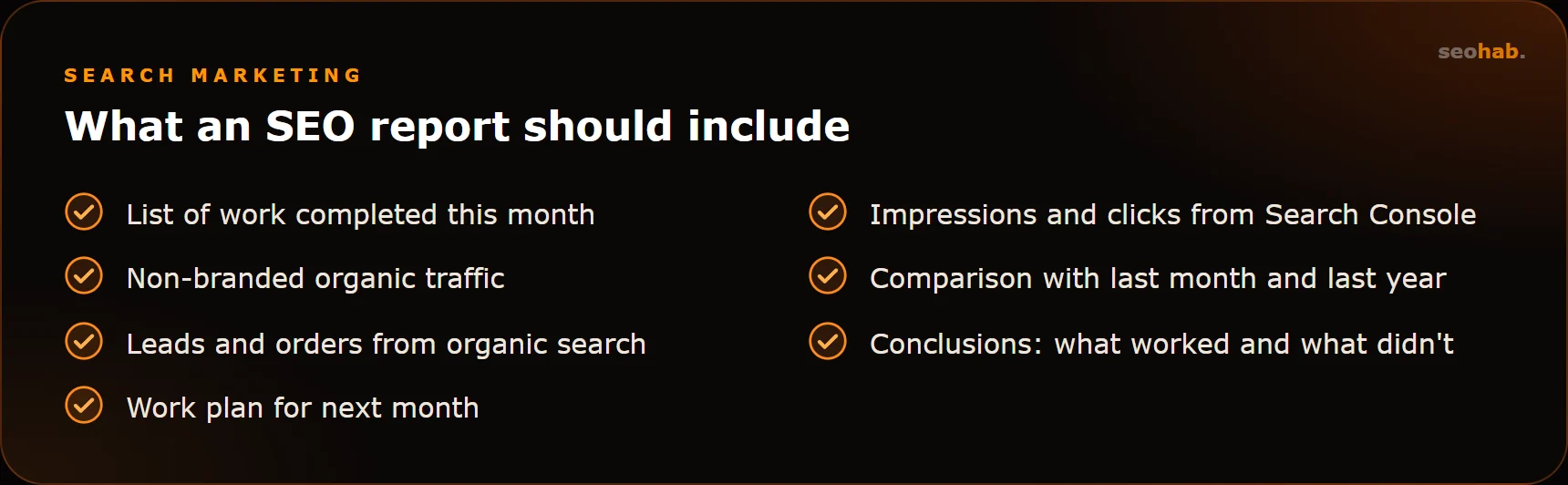
Ask for conclusions, not just numbers. "Traffic went down" with no explanation and no action plan is useless. Have the agency compare data with the previous year themselves, to separate seasonality from real changes.
How to verify the data yourself
Even if you trust your agency, it's worth opening the original sources once a month. It takes half an hour and gives you confidence that the report matches reality.
- Ask for guest access to GA4, Google Search Console, Yandex Metrica and Yandex Webmaster. The accounts should stay yours, not the agency's.
- In GA4, open the traffic acquisition report, filter for organic search and compare the current month with the same month last year.
- Check conversions for the organic segment: is the number of leads growing?
- In Search Console and Webmaster, see which queries gain impressions and clicks. If only your brand ranks well, non-branded demand is untapped.
- Review landing pages: traffic should reach commercial pages, not only blog posts.
If the report and the original sources disagree, it's not necessarily a sign of deception: the agency may have used a different period, segment or attribution model. Ask them to state clearly where the data comes from and which filters were applied, so cross-checking takes minutes.
Red flags in reports
Some signs show that the work isn't adding value or that a report is hiding problems:
- The report contains only rankings, and the keyword list changes month to month.
- Traffic grows thanks to informational articles unrelated to your product.
- There's no plan for next month, or it repeats word for word.
- The agency won't share analytics access or keeps tracking on its own account.
- The report doesn't compare year over year or explain seasonal swings.
- Questions about leads are met with "SEO isn't about sales".
Be especially cautious if the agency offers quick growth tactics such as bulk link buying or faking behavioral signals. They may produce a short spike, but the risk of search engine penalties falls on your site, not on the contractor.
When to evaluate and what to compare against
SEO is a cumulative channel, so you can't judge it by a single month. Technical fixes may show an effect after pages are recrawled, while work on content and structure pays off gradually. Look at the quarterly trend and year-over-year change, not at fluctuations between neighboring months.
It's also useful to compare organic search with other channels. If a lead from search costs noticeably less than one from paid ads, SEO pays off even with slow growth. For more on splitting budget between channels, read SEO or paid search.
Summary
SEO results are evaluated along a chain: visibility, traffic, visit quality, leads and revenue. Rankings are a supporting metric, while the key KPIs are non-branded organic traffic and leads from search. Demand a report with completed work, conclusions and a plan, and keep analytics access in your own hands.
To see the path from search query to closed deal, set up lead delivery into your CRM — something we handle as part of automation. And if you want SEO with transparent reports and clear KPIs, see how we work on the SEO services page.
Read also
 SEO
Schema.org Markup: Which Types Your Business Needs and How to Get Rich Results
Which Schema.org types a business website actually needs, how to implement and validate them, and what decides whether you get rich results in search.
 SEO
E-commerce SEO: Categories, Product Pages, Filters, Duplicates and Pagination
How to set up the catalog, categories, product pages, filters and pagination so your store gets traffic from Google and Yandex instead of drowning in duplicates.
 SEO
Local SEO: Ranking in Google Business Profile and Yandex Maps for Businesses with an Office
A step-by-step guide to local SEO: Google Business Profile and Yandex Maps listings, reviews, multiple locations, linking maps to your website and common mistakes.